Uneasy is the head that wears a crown, the old bard once wrote, but truly what does that mean? Does it mean being unsure who you can trust? Does it mean struggling to make basic decisions of your station for fear of harming those who rely on your aid? Does it mean having your perception warped so by the intoxication of power that you can no longer see those you serve as people, but building blocks to maintain your seat of dominion? It's all of these things and more, of course. Today, we're going to talk about a game that balances the topic of structural power alongside comedy, tragedy, and a cast of colorful and lovable characters. Today, we're talking about Sovereign Tower.
Before I go any further, please play Sovereign Tower. I won't be getting into any real spoilers here, but the game's worth playing and this is my main call to action: please just play it, you'll probably love it.
My Expectations
I reviewed this game's demo as part of my 17 Steam NextFest demo reviews previously, and really enjoyed it, so I had a pretty good idea of the content of the game. By my experience, I knew that it was a comedy-focused kingdom management simulator/visual novel with more of a focus on individual character storylines than an overarching plot. I knew that the graphics were a really detailed, almost storybook-like 2D artstyle. The music I had noticed was minimal, outside of Hildy's song (by incredible bardcore artist Hildegard von Blingin', like much of the OST), and the sound design was solid. More than anything, though, I thought the gameplay of managing the actions of your knights was compelling, and that learning their stories by diverting their lives through several routes was interesting and enjoyable. Beyond the demo content, I assumed there would be a number of acts with big penultimate bosses, a punishment for using the demon time rewind system, and many secrets and more knights than you can carry, complete with several endings.
What is Sovereign Tower?
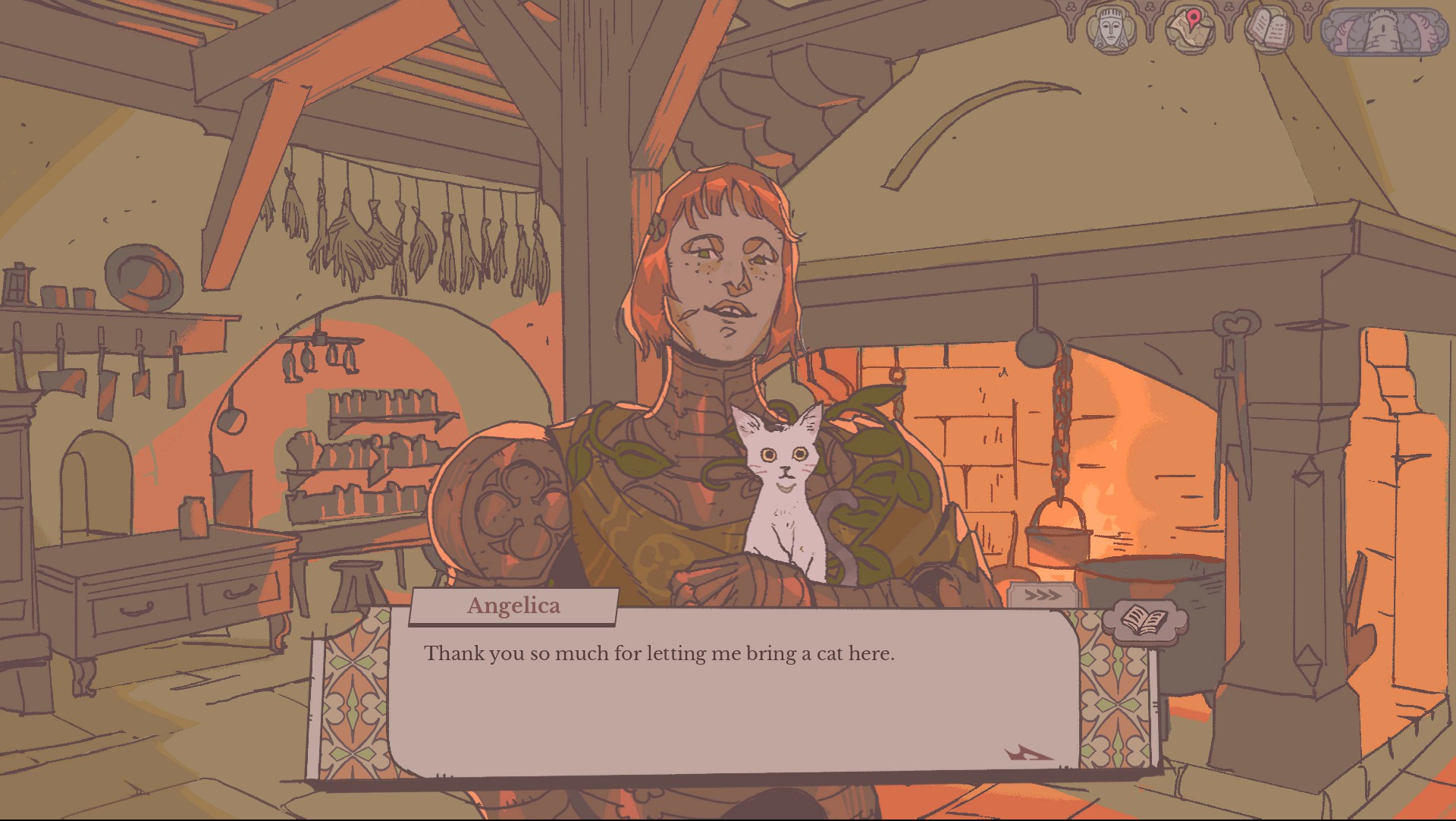
Sovereign Tower is, as previously stated, a comedic visual novel-slash-kingdom management simulator with a focus on player choice. You are the Sovereign, a wanderer with leprosy who dons a mask of stoicism (in clear reference to King Baldwin IV (the depiction from the movie Kingdom of Heaven, not the real one, you pedants)) who wandered one day into The Tower. This tower, sealed for ages to the unworthy, has chosen you as the ruler of the Kingdom of Brizh, and among its gifts includes a stasis on your condition, anti-regicide defenses, an ever-growing list of fortifications to meet the needs of your servants, and most importantly, a demon in a lock in the basement who is willing to make a pact with you to rewind time while keeping your memories intact, for seemingly no cost. Your job is to gather knights to your round table, gather alliances, defend against those who would dethrone you, and solve the problems of the citizenry, be they monetary, diplomatic, or solvable by good old fashioned combat. You'll get to know the circumstances your knights and subjects face, and how best to handle their problems and curry their favor, as you trudge ever forward towards the borders of your domain.
Graphics
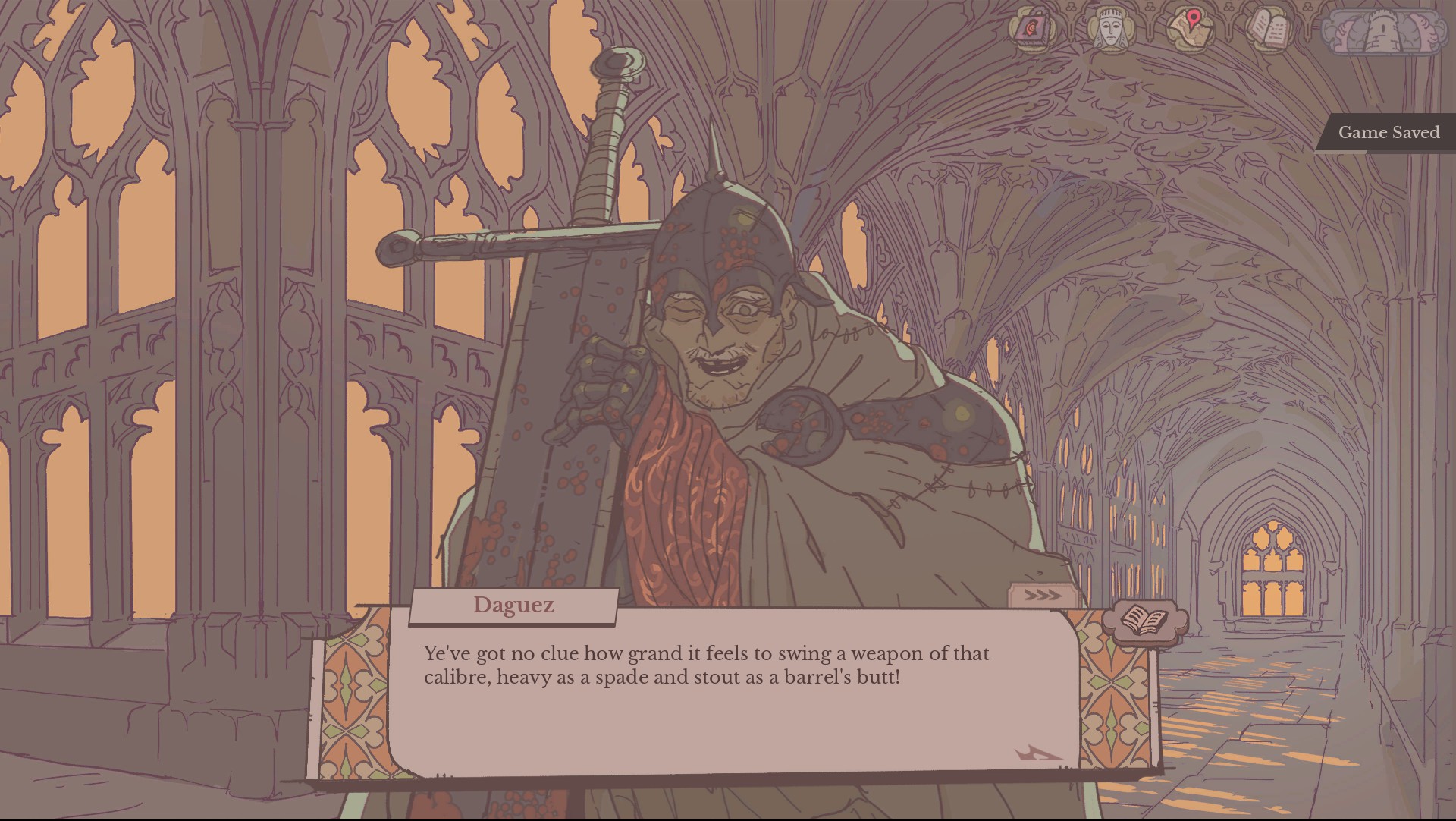
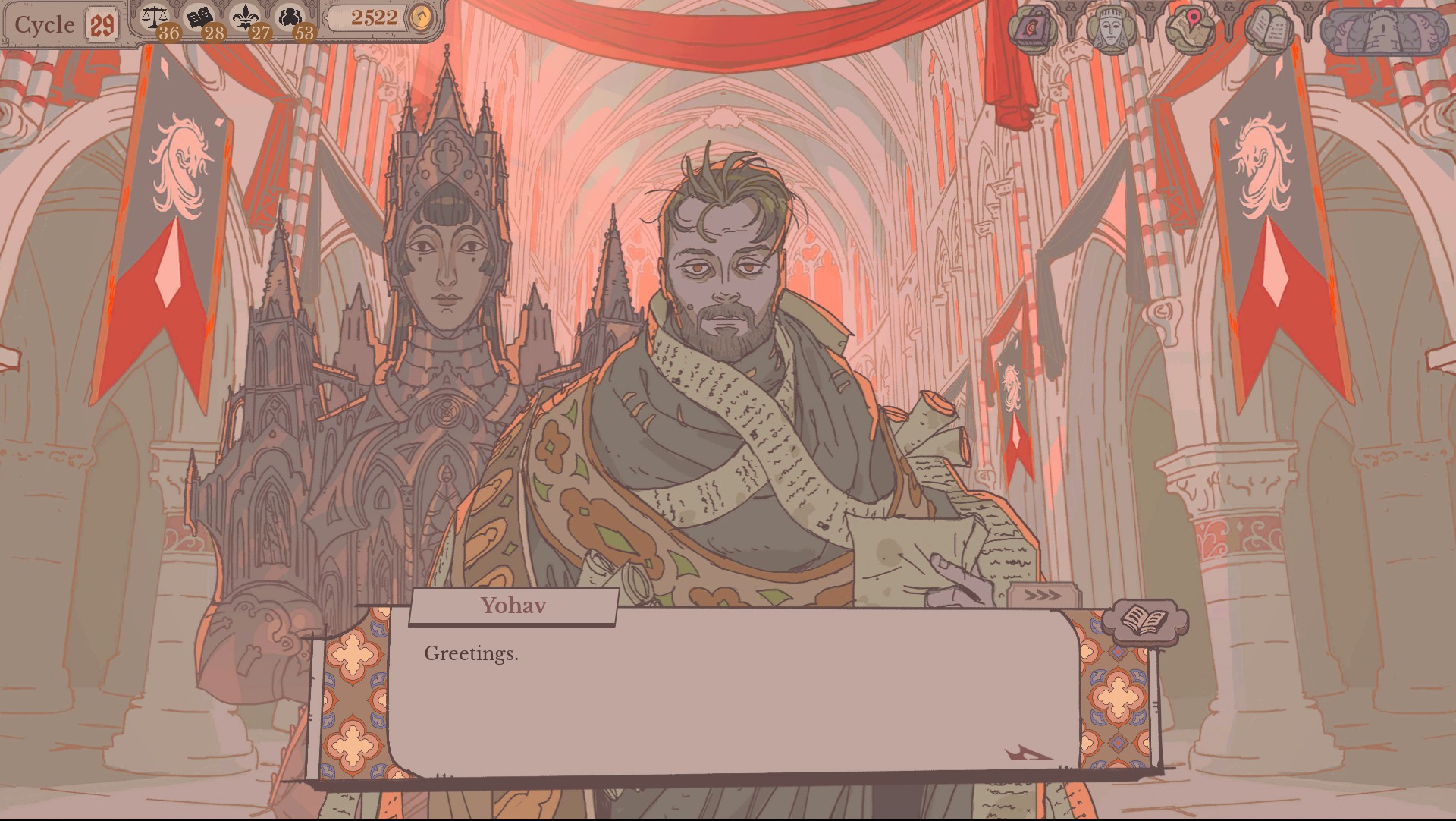
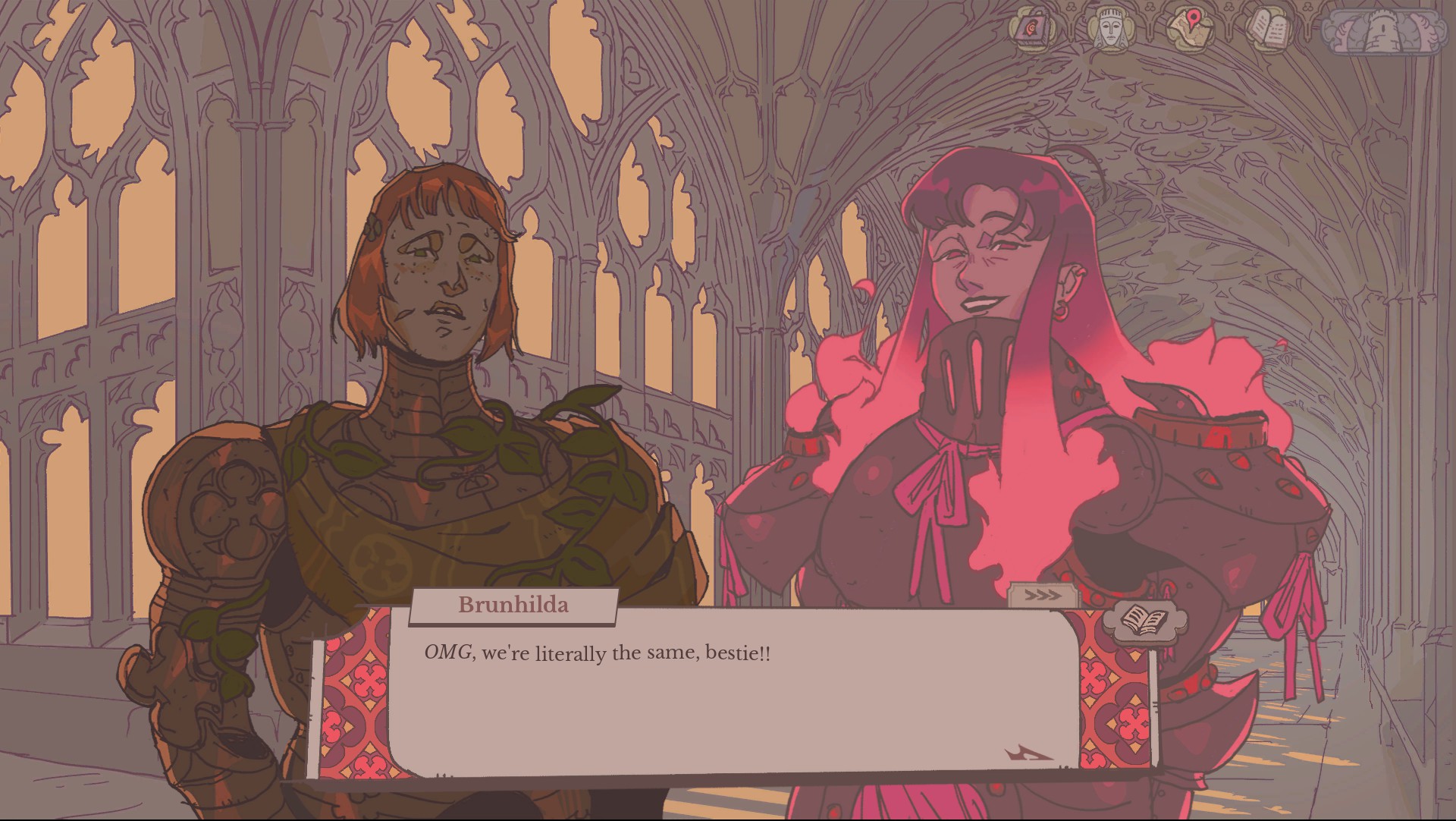
This game looks beautiful. The art is lovingly crafted in the storybook style I mentioned above that also exists within Wild Wits' previous game, Crown Gambit, extending to character sprites, backgrounds, and CGs. Even the UI bears that consistent style that makes you feel like you're opening up an illustrated book in the library that's a century or two older than you are, it's delightful. It's a gorgeous and intricate stylistic choice that I don't think many studios could pull off, but Wild Wits as a small studio does it masterfully. Every character's sprite is as expressive as they are, with some characters having wild and varied poses, and some being more static in their stoicism. Some change in response to certain events, and those changed portraits have their own sets of animations to fit. You can tell they were all crafted with love. Many characters are visually references to existing fantasy characters, with obvious ones like Goberto looking like Patches, but also funnier ones like Yohav and his guard knight Gothild looking like adult Macaulay Culkin standing next to the McCallister house from Home Alone.
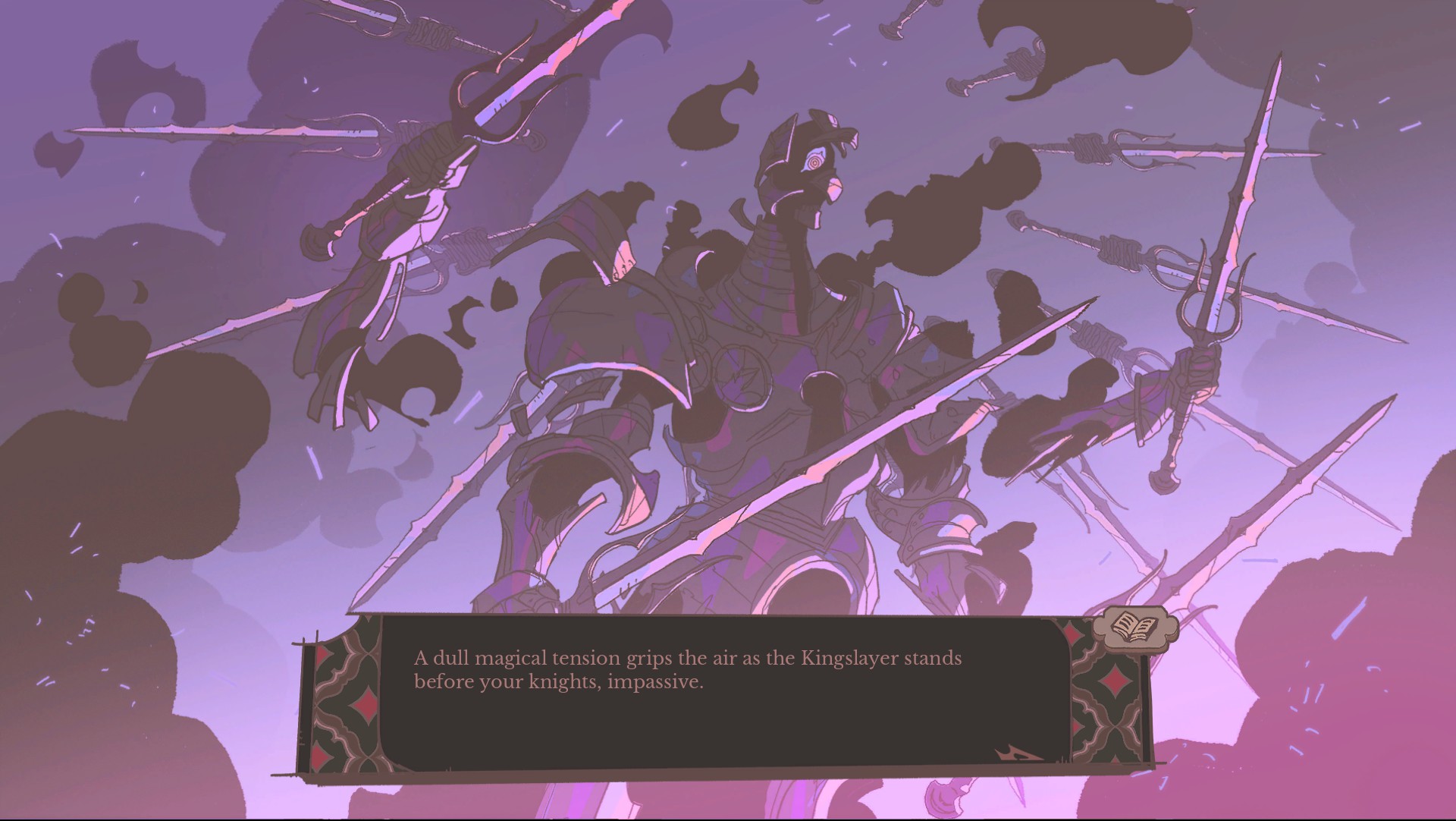
Backgrounds in this game are simple but solid. They really played well with the scope of this game, as you don't really see many backgrounds because you can't leave the tower due to your leprosy. As a result, they put a lot of effort into making the few backgrounds you >do see look great, and it shows. The halls look old and decrepit and the quarters of your servants look personal and lived-in. The small places of everyday peace like the garden or kitchen are drawn as sanctuaries for the everyday life of our beleaguered knights. The audience chamber/throne room, the one you see the most, is given the gravity it deserves, too. The castle exterior growing and changing with time is noticeable and feels great to watch, and all the relics, consumables, and mounts are themselves different and cool. CGs in the game are pretty minimal, as this isn't a focused VN, and yet they're all fantastic. Giant, climactic battles against daunting foes are displayed as the horror they represent, with many characters even exclaiming as such. It all works as one big package.
Gameplay & UI
The gameplay in Sovereign Tower is an extremely satisfying and consistent loop. Each day, you see a number of subjects and emissaries seeking an audience, and either solve or commit to solving their problems. You then prepare your knights to go solve issues that require direct intervention, with each knight having their own strengths, weaknesses, and dispositions. Some knights might love hunting monsters, while others might prefer to peacefully reconcile differences, and you have to balance these aspects with the types of quests their statistics lend themselves towards. It's no use having a knight that loves doing diplomatic work if their charisma isn't very high, after all, as they'll never succeed at those quests. For the most part, this is solvable for any outliers, though; as knights complete quests they gain experience and level up, allowing you to place a point in any stat of your choice to help round out weaknesses or make them better at their strengths. It works really well, and I've found the decision-making of where to place each point to be a really compelling way to handle character growth. Alongside this, characters will have their own character quests, which can involve simply talking to them before missions or can involve sending them on specific quests, giving them specific items, or other, more complex dealings. It all works quite well, and I think that this is most of where the strong suit of the game lies.
Along the same vein, the game cares a lot about player choice. Most things you say are attributed to one of four Sovereign Archetypes: Audacity, Wisdom, Tyranny, and Kindness. Over time, by making decisions towards one of these paths, you'll rank it up (to a max of 3), and by reaching certain thresholds you'll unlock new, color-coded dialogue options for them. While this obviously affects the progression of individual parts of your run and how easy it is to curry favor with different factions of people, it inevitably concludes in your ending, with a number of endings available based on how you acted, a neutral catch-all ending, and a more specific, true ending with its own requirements. This mostly feels great, but what if you mess up and accidentally do something that's against your intended route? Well, that's what the demon in your basement is for. Your demon can rewind you as far back as the beginning of the current act to redo decisions and sometimes gain new dialogue options with the power of foresight. It's a really cool system that you'll need to engage with in order to properly enjoy the game, so don't be afraid of using it early on. My only real complaint, in terms of general gameplay, is that the bonus thresholds for the final boss encounter needed a serious second pass. As they stand, they can really make your efforts feel meaningless depending on how you've played.
The UI in the game is pretty, but ultimately could have used another pass. The basic choice functionality in the audience and dialogue is absolutely fine, but I had many points where the Map screen would simply bug out and refuse to allow me to interact with missives to be sent out. With specific characters, namely Edith and Tarcus, the intendency didn't function properly. There are a number of grammar, spelling, and usage issues that snuck through that I think would have been easily caught by an editor, such as the "Dualist Sword" and how it "breaks the enemies blade". The inventory gets messy quite fast, and with no way to sort items at all, you're simply going to have to remember what everything does or scroll slowly through the list later on to find exactly what you need. Additionally, due to how choices are tracked in the game, you can get into weird situations where you can complete the same unique event twice, or sometimes a character will simply assume you acted in a way you've haven't. This review was written a few days after release, though, and if the issues here are fixed as they've shown they're very capable of doing, I'll be happy to bump the score up.
Heavy is the Hand that Cranks the Hog
Heavy is the head that wears the crown, and that's true in Sovereign Tower too. While dealing with the issues of your knights and subjects, you'll grapple with what power means to you, and whether you can truly solve the problems of your people. The game doesn't get too incredibly deep into the subject, but the idea of the goofy, jokey kingdom management simulator actually talking about things like power structures and the toxic nature of ruled governance is beyond charming. It is personal and political, as all good things are, and it has you consider at multiple points if what you're doing is right. Doing things the "right way" for you will look differently than it does to others. At multiple points I felt an intense moral conundrum of between "the right way" to handle a problem and "what will give me the favor of the faction I'm courting?". It was a strange feeling to experience the rationale of "the ends justify the means" in my head, and the variation and volatility of the routes along with the desire to see more of the secrets the game is hiding from you will make you question those little decisions bit by bit. I love it. Can you truly find love amongst your subjects, or will the structure of monarchism always keep you one pace away from those you care for, and thus leave you always alone? It's small things like this that the game touches at while keeping an upbeat and often hopeful tone. You help little people with their little problems, which inevitably causes problems for others. That's life, and you'll need to come to terms with that.
The Verdict
I love this game, despite its flaws. Could it use another pass by an editor, and maybe some bugfixes and polish? Yeah, but so could a lot of games I love. It's not some perfect amalgamation of what visual novels should be, or a major political statement about some incredibly important crisis plaguing humanity. It's a fun game with a cool premise that gives you a lot of control and sometimes makes you live with the consequences, and that's all it needs to be. I'm giving Sovereign Tower a score of 8/10, and you can bump it up to 9/10 if the aforementioned issues are fixed in the future.